
Push the Rock Online servers, collision, and the 18-player cap
How shared servers work in Push the Rock, what the player cap means for the solo grinder, and why eighteen avatars do not equal eighteen boulders.
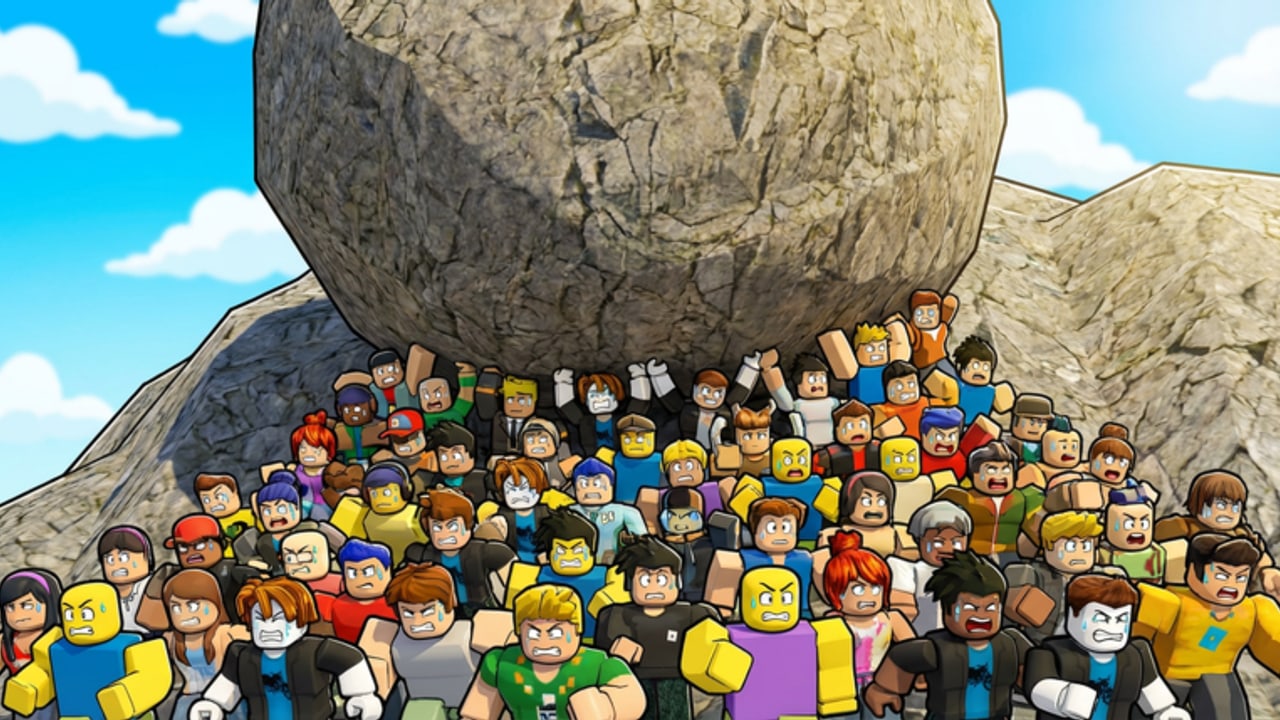
Push the Rock runs on online multiplayer servers with a maximum of 18 players per instance. This page explains how those servers work, what the player cap means for progression, and why the solo grinder should not treat the online setting as a requirement.
The experience is Studio Stinky’s place 139574563597312, universe 9745798212, last updated 13 April 2026. Server mechanics described here are consistent with public tracker data and player footage.
The 18-player cap
Each server holds a maximum of 18 players. This is a hard cap listed on public trackers. When a server is full, new players queue or join the next available instance.
The player cap affects the hill in two ways: crowded early-world servers with lots of new players, and sparse late-world servers where the 0.4 percent World 4 club is spread thin across instances.
A full World 1 server can look chaotic. Eighteen new players all pushing the same boulder on the same lane produces multiple simultaneous rollbacks. The crowd is not stronger; it is louder. Each avatar still has its own fatigue timer and its own rollback risk.
Shared space, individual progress
Every player on the server pushes the same boulder. This is not a design mistake. Studio Stinky’s pitch includes “push the rock all the way to the top” as a shared challenge. Other avatars are collision on the hill, not NPCs offering quests.
Progress is individual. Badges, coins, partners, and muscle are per-account. Other players on the hill cannot complete your badge, collect your coins, or spend your partner unlocks. The shared boulder is a shared workspace; the rewards are solo.
This means the 18-player cap is not a gate on your progression. A solo player can complete the full loop — push, slide, spend, unlock — without another person on the hill. Other avatars are traffic, not party members.
Collision and rollback lanes
Physics collision is active in Push the Rock. Avatars bump each other. Boulders can collide. The exact collision rules for boulder-to-boulder contact are not published, but player footage shows that multiple boulders do not merge into one super-rock.
Rollback lanes are per-boulder. If Player A pushed up the left lane and Player B pushed up the right lane, both lanes become rollback hazards when those players’ avatars tire. The lanes do not cancel each other out.
Standing in any active rollback lane risks a crush regardless of which boulder caused it. The how to survive rollback page covers the sidestep; this page covers why the server is full of rollback sources at once.
Server hopping and instance switching
Players can leave a server and join another. There is no penalty for switching instances. The muscle system, coin balance, and partner board are tied to the account, not the instance.
Reasons to switch servers include: a crowded World 1 with chaotic multi-boulder rollbacks, a dead server with no activity, or chasing a specific badge club. Reasons to stay include: a functional World 2 grind, an active community session, or momentum on a long run.
There is no documented optimal server-hopping strategy. The game does not publish instance-level badge rates. Switching servers to find a “warmer” World 4 club is not a confirmed strategy; it is speculation based on how other Roblox games handle low-population late-world instances.
What the online setting does not mean
Online does not mean co-op puzzle-solving. There are no documented shared objectives that require two players to complete. The badge unlock conditions are individual.
Online does not mean trading. Push the Rock does not have a documented player-to-player trade system. The partner board is a store, not a marketplace.
Online does not mean voice chat is expected. The Roblox listing does not advertise voice chat as a feature. Camera and movement controls are standard Roblox; this wiki will not invent a push-to-talk keybind that does not appear on the official controls list.
Server size and late-world difficulty
Worlds 4 through 6 have win rates below 1 percent. On an 18-player server, that statistically means most full servers do not have a single player who will earn those badges during that session.
The low badge rates are not a server-size problem. They are a difficulty problem. The hill gets harder, not the matchmaking. A solo player on a quiet server has the same World 6 chance as a player on a full server, adjusted for the fact that the solo player is not sharing collision risk with seventeen other rollbacks.
R15 and avatar considerations
Push the Rock uses R15 avatar rigging. This affects animation and collision box compared to R6 servers. There is no documented advantage or disadvantage for R15 specifically in this experience; it is the standard rigging for modern Roblox games.
Custom avatars function in Push the Rock. There is no documented costume bonus or stat penalty tied to avatar type. The Squid Game mask partner mentioned in partner tier discussions is a board unlock, not an avatar skin.
What we do not know about servers
We do not have confirmed data on server matchmaking logic, instance creation triggers, or how Roblox balances new players across busy and empty servers.
We also do not have confirmed data on whether late-world servers are cross-instance in any way, or whether the “World 4 club” is a per-server phenomenon with no cross-pollination.
The solo grind and the online setting
Push the Rock is playable solo. The online server is not a co-op requirement. A player who never interacts with another avatar can still earn every badge, buy every partner, and reach the muscle ceiling.
The online setting is infrastructure for community, not a gate on progression. Use it as a social layer when it helps; ignore it when it does not.
Frequently Asked Questions
Quick answers for hill climbs, partners, and world badges.
How many players can join a Push the Rock server?
Up to 18 players per instance. This is a hard cap, not a recommendation.
Do I need other players to progress?
No. Badges, coins, partners, and muscle are per-account. Other players are traffic, not party members.
Can I trade with other players?
No documented trade system exists. The partner board is a store; there is no player-to-player marketplace.
Do other players' rollbacks affect me?
Yes, if you are in the rollback lane. Multiple players on a busy server mean multiple rollback sources. Watch the whole slope, not just your own boulder.
Should I switch servers to find a better late-world club?
There is no confirmed benefit. Badge rates are per-account, not per-server. Server-hopping is optional, not required.
Is voice chat expected in Push the Rock?
No. The Roblox listing does not advertise voice chat. Use standard Roblox controls; do not expect push-to-talk to be part of the experience.